Three of Swords — Tarot Card Meaning
Swords
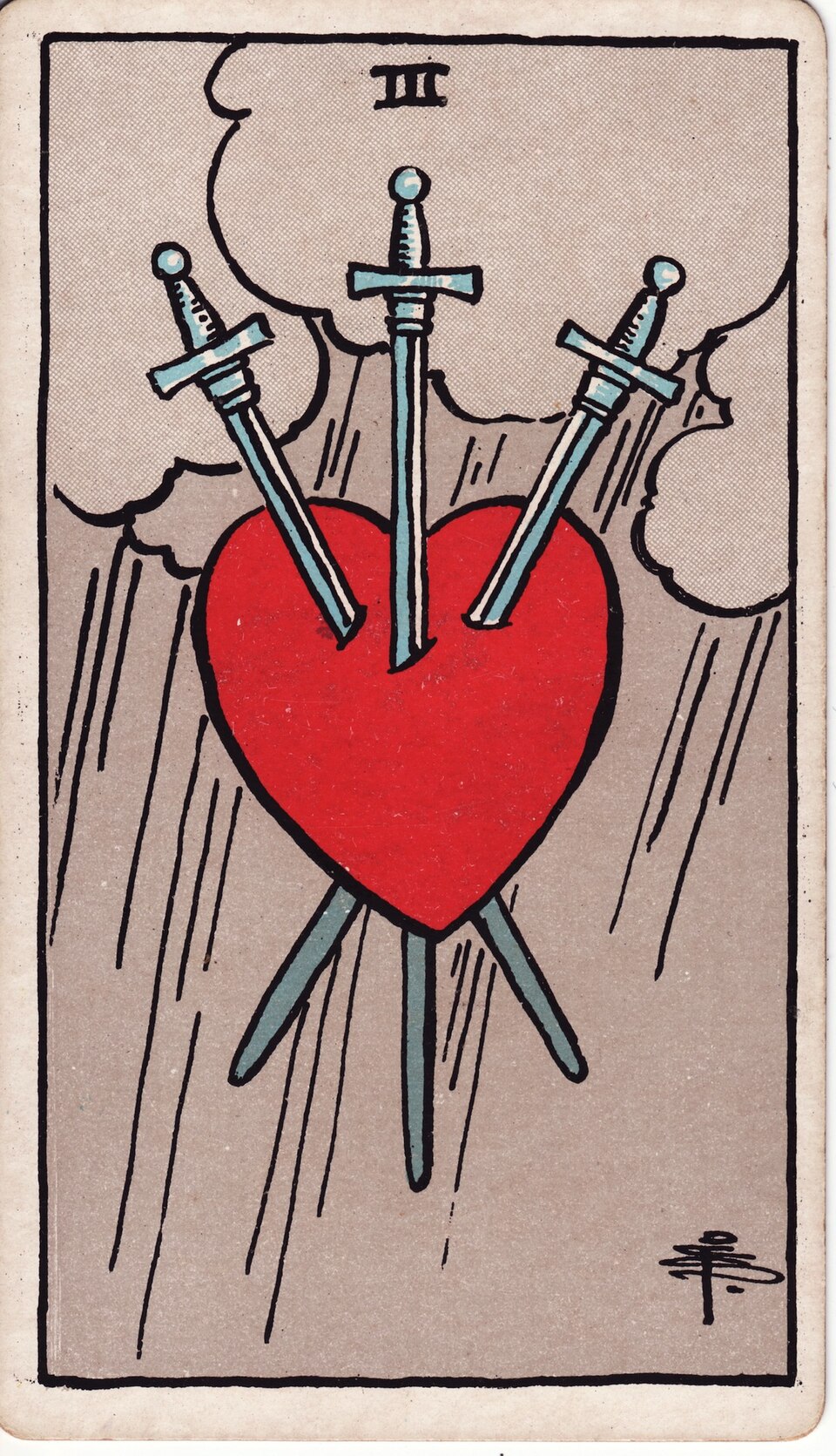
The Three of Swords is one of the most misunderstood cards in the Minor Arcana. It is often feared for its depiction of a heart pierced by three blades, yet its real meaning is about the surgical precision of truth. This card does not bring pain as punishment; it brings pain as revelation. When it appears, something false is being cut away so that you can finally see clearly.
Upright meaning
The upright Three of Swords signifies a piercing emotional wound that is impossible to ignore. This card appears during acute heartbreak, betrayal, infidelity, or a shattering disappointment, but its deeper purpose is to cut through self-deception. The three swords each represent a specific kind of truth: one about a relationship, one about your own role in the suffering, and one about the other person's true intentions. Upright, this card forces you to see pain that you have been avoiding, often through rationalization or wishful thinking. The heart is surrounded by storm clouds, but the sky is not black; it is grey, indicating that this is not an endless devastation but a cleansing storm. When this card appears, you are being asked to stop poisoning yourself with a false hope. The pain you feel is the exact measure of how much you have invested in an illusion. This is a card of 'painful clarity.' It does not ask you to forgive or to forget; it asks you to first allow yourself to acknowledge that something is broken. Only by fully admitting the injury can you begin to heal. The upright card is a covenant with truth: you will hurt, but the hurt will become a compass that guides you away from similar circumstances in the future.
Reversed meaning
The reversed Three of Swords marks the slow, uneven process of healing from a wound that has already been inflicted. Here, the swords are not stuck in the heart but are beginning to be pulled out, which can still cause a sting, yet the direction is toward recovery. In this position, the card often signals that you have already survived the most acute phase of grief and are now integrating what happened. You may find yourself revisiting memories or reliving conversations with less emotional charge. However, the reversed card also warns against an unhealthy 'moving on' that is actually denial. If you have not processed the initial pain, this card can indicate that you are suppressing it through overwork, substance use, or cynical detachment. It can also point to self-inflicted suffering: you might be replaying a betrayal in your mind and turning it into a core identity. When reversed alongside cards like The Tower, it suggests that the worst is over, but only if you actively choose to release resentment. The reversed Three of Swords does not promise that the wound the blade left is completely gone; it promises that the bleeding has stopped. The remaining scar is a reminder of what you have learned, not a reason to continue living in the past.
In love and relationships
In the context of love, the Three of Swords can be a devastating card. For those in a relationship, it often predicts a period of arguments, cold silences, or a betrayal that severs trust. One partner may have been living in a different emotional reality than the other, and the card brings this mismatch to the surface. It can also mean that a relationship is ending because a fundamental incompatibility can no longer be ignored. For singles, this card frequently points to past heartbreak that is still dictating your current choices. You may be rejecting healthy partners because you are still expecting them to repeat the betrayal of an ex. Alternatively, the Three of Swords can indicate a 'karmic lesson' involving a love triangle or a relationship with a persistent obstacle. The key is honesty: if you are seeing someone who is not fully available, this card demands that you face that fact rather than rationalize it. It does not always mean permanent separation. In a reunion context, the Three of Swords suggests that a painful conversation is the necessary price for any future intimacy. Love without truth is merely performance. If you choose to stay, you must consent to being fully seen, including the parts of you that are wounded, and you must allow your partner the same.
In career and finances
The Three of Swords in career settings brings a brutal but liberating truth. This card often appears when you have been promoted to a position that you secretly hate, or when a project you have poured your heart into is rejected by your manager or clients. It represents layoffs, disciplinary actions, or the discovery that a colleague has been sabotaging you. Yet the swords are also the element of intellect, so this is not merely a random misfortune; it is a signal that your current professional path is misaligned with your values. The pain you feel is the cost of seeing that misalignment. In financial matters, the Three of Swords is a warning to face your numbers head-on. You may have been ignoring credit card payments, tax obligations, or the fact that your business is burning through cash. This card demands immediate, clear-eyed action: cut a failing product line, cancel a subscription you cannot afford, or accept that you need to change careers. A common interpretation is 'the pain of a needed cut' — literally, a cost-cutting measure that will feel unpleasant but will prevent a larger collapse. It also warns against co-signing loans or merging finances with someone who is not financially trustworthy. Use the energy of the swords to make a decision based on data, not hope, and you will emerge leaner and more stable than before.
The card's advice
This card's advice is deceptively simple: let it hurt. Society teaches you to suppress sorrow, to put up a brave face, and to medicate your feelings with distractions, but the Three of Swords warns that unprocessed pain does not disappear; it calcifies into bitterness and distrust. Find a private space, a therapist, or a trusted friend, and speak the painful truth aloud. When you name your betrayal, your grief, or your failure, you take its power to operate in the shadows. The card also advises you to stop negotiating with illusion. If you are in a situation that requires you to ignore your own instincts, walk away from it. The cost of remaining in that false peace is greater than the temporary pain of the cut. Furthermore, this card recommends that you separate your pain from your identity. You experienced heartbreak, but you are not a heartbroken person. The swords are external; the heart is still beating underneath. Let the rain fall, but do not build an altar to it. Use the clarity of this card to set new boundaries, to ask for what you deserve, and to communicate honestly even when it is uncomfortable. The pain that you can feel is finite; the regret of never having faced it is infinite.
Combinations with other cards
When the Three of Swords appears with the Two of Cups, it often indicates a relationship that started beautifully but is now being tested by a secret or a misunderstanding; the combination insists that the two parties must open their hearts and speak the unspoken truth or the connection will corrode. With the Ten of Swords, the pain becomes conclusive — a final breaking point, the end of a repeating pattern, and a warning that you must not resurrect a situation that has died. Paired with The Star, this card is a promise of healing: the tears are real, but the water they form is the very wellspring of your future hope. With The Hermit, the Three of Swords points to the painful necessity of withdrawing from the world to process sorrow; solitude is not exile, but a workshop for the soul. In a money reading, the Three of Swords with the Five of Pentacles suggests that a financial shock may push you into debt, but also that temporary hardship is the bridge to a more secure future if you accept help. When combined with the Queen of Swords, the message is to use your sharpest intellect to cut through emotional fog; this card supports a rational, even stern, evaluation of people who have caused you pain.
Frequently Asked Questions
Does the Three of Swords always indicate a breakup or betrayal?
No, it can also indicate the end of a friendship, the failure of a hope, or the discovery of an unflattering truth about yourself. The common thread is a sharp and painful revelation that forces you to see things as they really are. A breakup is the most common expression, but the card's energy can be present in creative rejection, a religious crisis, or a sudden medical diagnosis. The key is the piercing of an illusion.
Is the reversed Three of Swords a completely positive card?
Not necessarily. It generally means healing is underway, but it can also signal that you are avoiding the pain, denying that it exists, or using self-blame as a way to control an uncontrollable situation. If you find yourself acting cynical or numb, the reversal is asking you to return to the felt experience of grief, not to jump into forced positivity.
How long does the effect of this card last?
The Three of Swords describes an event or a phase that can last from a few days to two years, depending on the surrounding cards and your own emotional resistance. Tarot timeframes are symbolic, not literal. If the card appears at the beginning of a question, the pain is in the foreground; if it appears as a result card, it is a warning to make a change before the pain becomes chronic.
How should I use this card for spiritual growth?
The Three of Swords is a master class in detachment. It invites you to observe your own suffering without merging into it, in the way a surgeon observes a wound while still caring for the patient. Meditate on the image: the heart remains intact despite the blades, meaning you are not your grief. Every time you feel the sting of truth, ask yourself what durable strength you can extract from the lesson. Over time, you will find that this card has gifted you with heightened empathy and a much lower tolerance for lies.
What is the main difference between the Three of Swords and the Ten of Swords?
The Three of Swords is the initial shock and acute grief of a painful truth. The Ten of Swords is the near-exhaustion of a long battle, the point where you have been metaphorically stabbed in the back and left for dead. The Three is the 'ah, this hurts' moment; the Ten is the moment that feels like the end of the world. The Three is followed by healing, while the Ten is followed by a new dawn because there is nowhere left to fall.
Discover Mystral
Learn how the Three of Swords interacts with the entire deck in Mystral's free daily card pull, and let the truth set your spirit free.
Try for free