Ten of Swords — Tarot Card Meaning
Swords
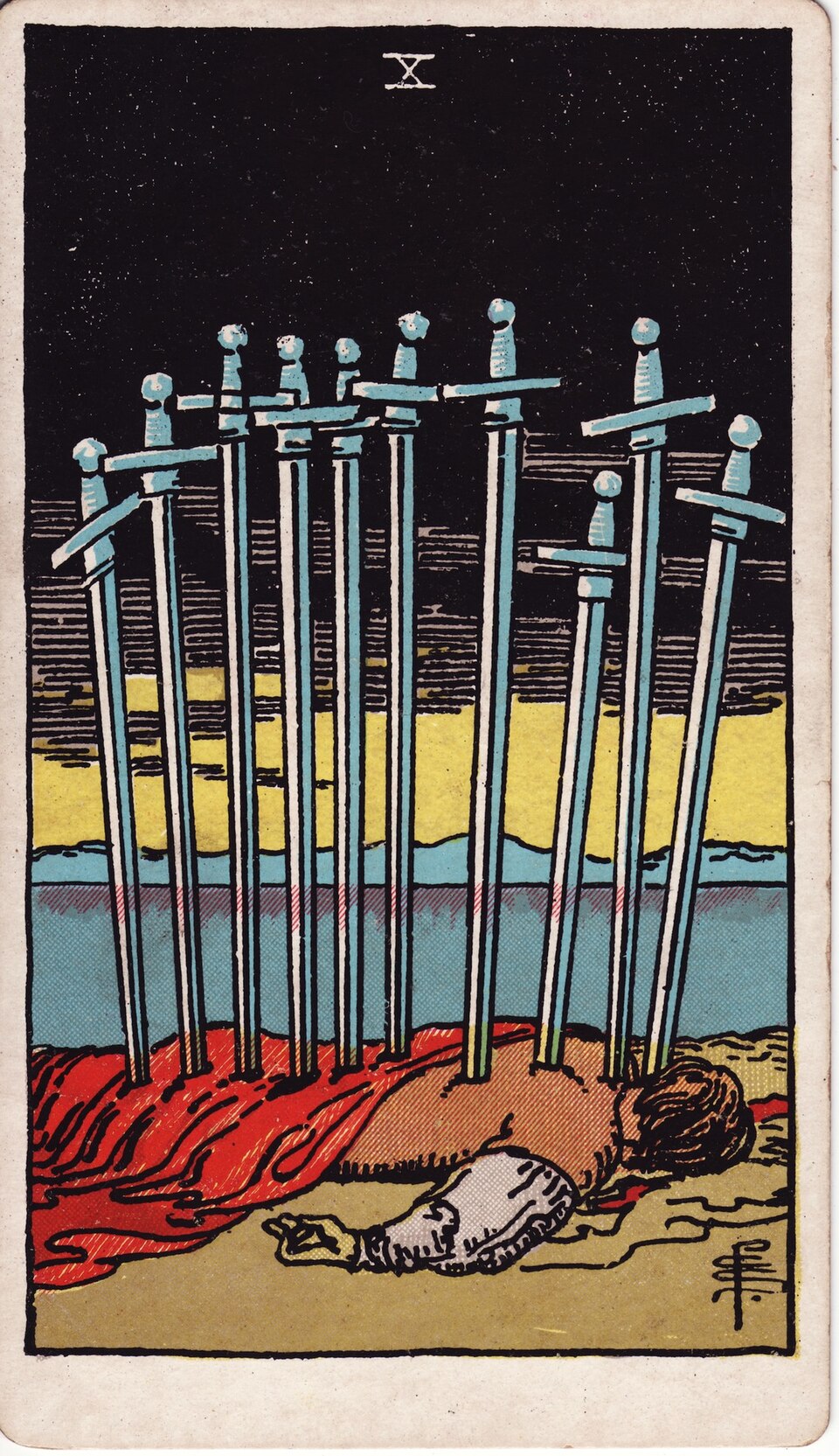
The Ten of Swords is the final card of the suit of Swords in the Minor Arcana, representing a painful but inevitable ending. It depicts a figure lying face down with ten swords piercing their back, symbolizing betrayal, defeat, and a complete collapse. Yet this card also carries the promise of a new dawn, as the sky in the background is not completely dark — the light of a new day is breaking. The Ten of Swords signals that a situation has reached its absolute limit, and the only way forward is through acceptance and release. This card is often misunderstood as purely negative, but its deeper meaning is about the catharsis that comes from letting go of what is already dead.
Upright meaning
When the Ten of Swords appears upright in a reading, it signifies a definitive end — often a painful one. This card represents the culmination of a cycle of mental suffering, betrayal, or deception. The ten swords stuck in the back of the figure indicate that the wound was inflicted from behind, suggesting that the source of pain may have been unexpected or came from someone trusted. In an upright position, the card forces the querent to acknowledge that a situation has reached rock bottom. There is no turning back; the only option is to accept the loss and allow the healing process to begin. The Ten of Swords is not about prolonging agony — it is about recognizing that the struggle is over, even if the outcome is not what was desired. Famous figures who have experienced such a devastating turning point include Steve Jobs, who was ousted from Apple in 1985; J.K. Rowling, who faced multiple rejections before Harry Potter was accepted; and Oprah Winfrey, who was fired from a television anchoring job early in her career. Each of them faced a moment that could be described as a Ten of Swords event, and each used that ending as a catalyst for profound transformation. The card's upright message is clear: stop fighting the inevitable. The pain you feel is real, but it is also the precursor to a new beginning. The sunrise in the background of the card is a subtle but powerful reminder that dawn follows the darkest night. Embrace the end, grieve honestly, and then prepare to move forward.
Reversed meaning
In its reversed position, the Ten of Swords indicates a resistance to the ending that is already happening. The querent may be trying to revive a dead relationship, a failing business, or a hopeless situation. This reversal often points to denial — the person refuses to accept that the pain is over or that the worst has already happened. Alternatively, the reversed Ten of Swords can suggest that the feared collapse did not occur as severely as anticipated. Perhaps the betrayal was not as devastating, or the loss was less permanent than it seemed. In some cases, the card reversed indicates a slow recovery from a traumatic event. The querent is still in the process of picking up the pieces, but they are holding onto the past instead of moving forward. This card can also warn against self-blame or playing the victim. The reversed energy calls for a realistic assessment: what is truly over, and what is just a fear of change? The card advises the querent to stop resisting the natural conclusion of a cycle. If the Ten of Swords upright is about the final blow, the reversed card is about the refusal to accept that the blow has been struck. It can also indicate that the lesson from the painful experience has not yet been fully learned. The querent may be repeating the same patterns because they have not allowed themselves to fully feel the loss. The reversal is a gentle nudge to stop looking back and to start the necessary work of healing. Only by acknowledging the end can the new beginning emerge.
In love and relationships
The Ten of Swords in a love reading is a stark indicator of a painful breakup, betrayal, or the end of a relationship that has been toxic for a long time. It often appears when a partner has been dishonest, unfaithful, or emotionally abusive, and the final blow has been delivered. The card suggests that the relationship is beyond repair — the wounds are too deep, and continuing would only prolong the suffering. For those in a committed relationship, the Ten of Swords can signal that the connection has died and that both parties need to let go. It may also represent a betrayal that has shattered trust irreparably. For singles, this card can indicate that a recent romantic disappointment has left them feeling devastated and cynical about love. The Ten of Swords advises against trying to resuscitate a dead relationship. It is time to accept the finality of the end and allow yourself to grieve. The card also asks the querent to examine their own role in the dynamic — were there warning signs ignored? Was the relationship built on false hope? The Ten of Swords does not promise immediate relief, but it does promise that the worst is over. In the context of love, this card is a call to surrender to the pain so that genuine healing can begin. It is a reminder that holding onto a relationship that has already ended is like trying to breathe life into a corpse. Let it go, mourn the loss, and trust that the sunrise will come again. Famous couples who have experienced a Ten of Swords breakup include Jennifer Aniston and Brad Pitt, whose marriage ended amid public betrayal; and Elizabeth Taylor and Richard Burton, whose passionate but tumultuous relationship finally collapsed. In both cases, the end was painful but ultimately freed both individuals to grow separately.
In career and finances
In a career reading, the Ten of Swords upright signals a major professional setback — a job loss, a failed project, a bankruptcy, or a betrayal by a colleague or boss. The card indicates that the situation has reached its lowest point. Perhaps the querent was fired unexpectedly, or a business deal collapsed due to deception. The Ten of Swords in this context warns that continuing to fight for the current position is futile. The company or role may be toxic, and the end is a liberation in disguise. Financially, this card can represent a significant loss, such as a stock market crash, a failed investment, or overwhelming debt. The card reassures the querent that the bottom has been reached; from here, the only direction is up. However, the card also cautions against trying to immediately recover the loss. The energy of the Ten of Swords requires a period of stillness and reflection before action. For entrepreneurs, the card may indicate that a business venture has run its course and must be closed. The advice is to accept the loss, learn from the mistakes, and avoid the temptation to blame others. The reversed Ten of Swords in career matters suggests that the querent is in denial about a professional failure. They may be refusing to update their resume, clinging to a dead-end job, or hoping that a failed project will somehow be revived. Financially, the reversal can indicate that the worst is over but the person is still stuck in a scarcity mindset. The card urges the querent to stop reliving the loss and to start planning for the next chapter. In both upright and reversed positions, the Ten of Swords in career and finances is a wake-up call to release old attachments and embrace a new beginning, even if it feels premature.
The card's advice
The Ten of Swords offers a clear and uncompromising piece of advice: accept the end. The card tells you that you have been fighting a battle that is already lost, and continuing to resist will only drain your energy. The advice is to stop trying to fix what is broken and to allow the situation to die. This does not mean giving up in a passive sense; it means surrendering to the reality of the moment. The Ten of Swords asks you to feel the pain fully, without numbing it or pretending it is not there. Only by experiencing the depth of the loss can you truly release it. The card also advises against revenge or blame. The swords in the back suggest that the betrayal came from behind, but dwelling on who did it will not change the outcome. Instead, the advice is to turn your attention inward: what lesson does this ending carry for you? The Ten of Swords encourages you to cut ties with toxic people, situations, or mindsets that have been holding you captive. It is a card of radical honesty — you must admit that the relationship, job, or pattern is over. The card's advice is also practical: take a break, rest, and allow yourself to heal before making any major decisions. The sunrise in the card is a symbol of hope, but it only appears after the night has passed. Do not rush to the new beginning before you have fully grieved the old one. The Ten of Swords reminds you that endings are not punishments; they are opportunities for rebirth. Let go of the corpse and walk toward the light.
Combinations with other cards
The Ten of Swords gains nuance when paired with other cards. With the Death card, the combination intensifies the theme of irreversible endings and deep transformation. Both cards indicate that a phase is over, and the Death card adds the element of a necessary metamorphosis. Together, they suggest that the querent must let go of old identities. With The Tower, the Ten of Swords points to a sudden, catastrophic collapse that may feel like a lightning strike. The Tower brings chaos and destruction, while the Ten of Swords confirms the finality of the event. This combination warns of a complete breakdown of a structure, whether it is a career, a relationship, or a belief system. With The Star, the Ten of Swords takes on a healing quality. The Star is the card of hope and renewal, and it assures the querent that after the devastation, there is a path to peace. This combination is a powerful reminder that the end is not the final word. With the Ace of Cups, the Ten of Swords indicates emotional healing after a painful breakup. The Ace of Cups represents new love, compassion, and emotional openness, signaling that the heart will heal and love again. With the Five of Pentacles, the Ten of Swords underscores financial ruin or material loss. The Five of Pentacles shows poverty and exclusion, and together with the Ten of Swords, it suggests that the querent may be at their lowest point financially. However, the combination also hints that the situation is stark but temporary. With the Page of Swords, the Ten of Swords can indicate that the painful ending was precipitated by gossip, lies, or intellectual betrayal. The Page of Swords represents communication, sometimes with a sharp tongue, and combined with the Ten of Swords, it warns of backstabbing or malicious information. These combinations help the reader understand the specific flavor of the ending, whether it is emotional, structural, financial, or relational.
Frequently Asked Questions
Does the Ten of Swords always predict a literal death or physical harm?
No, the Ten of Swords almost never refers to a physical death. It is a metaphor for an ending, usually of a situation, relationship, or phase of life. The imagery of the swords is symbolic of mental anguish, betrayal, and the finality of a painful experience. In rare cases, it could indicate a serious health crisis, but even then, it is not a predictive death card. The card is about the death of something old, not the death of a person.
Can the Ten of Swords ever be a positive card?
Yes, it can be positive in the sense that it marks the end of suffering. The Ten of Swords appears when a situation has reached its absolute worst point, which means things can only improve from there. The card is a clear signal to stop struggling and to accept the inevitable. This acceptance opens the door to healing and new beginnings. The sunrise in the background of the card is a promise of renewal. While the card carries pain, it also carries the gift of closure.
What does it mean if I keep drawing the Ten of Swords in readings?
Repeated appearances of the Ten of Swords suggest that you are stuck in a cycle of endings and resistance. You may be holding onto a situation that has already died, or you may be repeatedly attracting patterns of betrayal and loss. The card urges you to examine whether you are refusing to learn the lesson of a previous ending. It may also indicate that you are not allowing yourself to fully grieve and move on. The card is a call to break the cycle by accepting an ending completely.
How is the Ten of Swords different from The Tower?
The Tower represents a sudden, shocking upheaval that destroys a structure, often unexpectedly. The Ten of Swords, on the other hand, is the culmination of a long process of decline. The Tower hits like a bolt of lightning, while the Ten of Swords is the final blow after a gradual wearing down. The Tower is about chaos and revelation, whereas the Ten of Swords is about acceptance and surrender. Both cards indicate endings, but the Ten of Swords carries a sense of finality and peace after the storm.
What should I do immediately after seeing the Ten of Swords in a reading?
The best course of action is to stop all resistance. Do not try to fix the situation or revive it. Allow yourself to feel the pain and disappointment without judgment. The card advises you to rest, grieve, and reflect. It is not a time for action but for surrender. Once you have fully accepted the ending, you can begin to look for the signs of a new beginning. Practical steps include cutting ties with toxic people or situations, seeking emotional support, and giving yourself permission to heal.
Discover Mystral
Embrace the end to find your new beginning. Let the Ten of Swords guide you through the darkness into the light.
Try for free