Five of Wands — Tarot Card Meaning
Wands
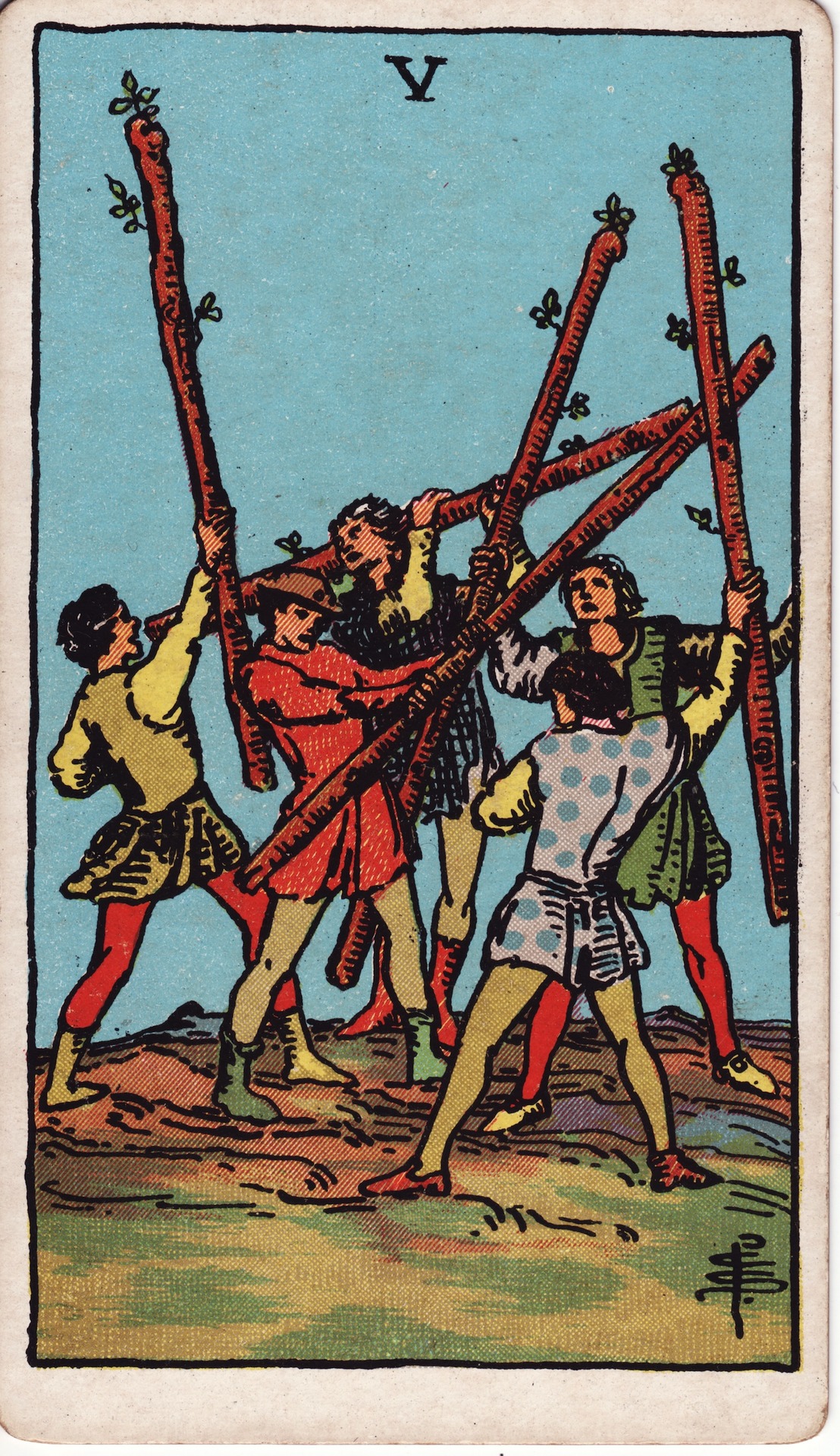
The Five of Wands is a Minor Arcana card that embodies the raw energy of competition, struggle, and constructive conflict. In the traditional Rider-Waite-Smith deck, it depicts five young men wielding staves in a chaotic scuffle, symbolizing the clash of differing opinions and the friction that precedes growth. This card does not predict defeat — it speaks to the essential role of rivalry in forging strength and clarifying your path.
Upright meaning
When the Five of Wands appears upright in a reading, it signals a period of active competition, challenge, or heated debate. Unlike the destructive forces of the Tower or the stagnation of the Five of Pentacles, this card's conflict is fundamentally productive. You are likely surrounded by multiple voices or agendas that demand you defend your position. This could manifest as arguments within a team project, rivalry among peers for a promotion, or simple creative tension that forces you to refine your ideas. The energy here is like kindling: friction generates heat, but heat can forge something useful. The card urges you to enter the fray rather than avoid it — passivity will leave you unheard and outmaneuvered. Every clash in the Five of Wands is an opportunity to test your mettle, sharpen your reasoning, and commit more fully to your own vision. The outcome is not predetermined to be negative; many successful alliances and innovations have emerged from these fire-tempered exchanges. However, because the card shows no clear victor, you must stay focused on your own goals rather than getting lost in the spectacle of the struggle. Upright, it may also indicate a healthy sports rivalry, a legal dispute that forces due diligence, or an artistic collaboration where clashing styles produce unexpected brilliance.
Reversed meaning
Reversed, the Five of Wands warns that healthy conflict has curdled into avoidance, sabotage, or unresolved frustration. Where the upright card encourages engagement, the reversal tells you that energy is dissipating in confusion or that disagreements have become personal and petty. You may be seeing backstabbing, passiveaggressive behavior, or a refusal to confront issues directly — people avoid the clash but plot in the shadows. Alternatively, the conflict may be internal: you are torn between competing desires and cannot decide which path to commit to, leading to procrastination and selfsabotage. The card reversed can also indicate that a competition ended unfairly or that rules were bent, leaving participants bitter. In some contexts, it points to bullying or toxic rivalry where the goal is not growth but humiliation. The key here is that the friction has been removed without resolution — team members suppress disagreement to keep peace, but innovation dies as a result. To move forward, you must either bring the conflict into the open constructively or cut ties with those who refuse to engage honestly. Unlike the upright card's promise of eventual clarity, the reversal can mean extended stalemate unless you actively remake the terms of engagement. Mediation, honest conversation, or a decisive withdrawal are the only remedies.
In love and relationships
For love and relationships, the Five of Wands upright often signals a phase of heated arguments that, while unpleasant, can actually strengthen the bond if both partners are willing to repair and learn. This is not the card of abuse or betrayal — it is the card of two strong wills butting heads over everyday decisions, household responsibilities, or differing social needs. Couples in a committed partnership may find themselves in a pattern of small squabbles that feel relentless but are ultimately about power dynamics rather than core values. The healthy approach is to treat each disagreement as a practice ground for better communication. However, the card can also represent outside interference: inlaws, friends, or expartners who inject tension into the relationship. If you are single, the Five of Wands suggests that you are currently in a dating environment where competition with other suitors is high, or where you attract people who are combative rather than cooperative. The reversed meaning in love points to unresolved resentment or partners who avoid confrontations to an unhealthy degree, leading to emotional distance. Sometimes it warns of a lover who cannot commit because they are still entangled in rivalry with an ex or a family member. Longterm, the reversal asks you to stop pretending everything is fine when it is not — speak the unsaid words before the relationship becomes hollow. A temporary separation or structured couples counselling may be necessary to break the cycle.
In career and finances
In career and finances, the Five of Wands upright announces a period of intense rivalry in the workplace. You may be pitted against colleagues for a promotion, fighting for credit on a joint project, or defending your creative ideas in a competitive market. Entrepreneurs often see this card when entering a saturated market where many players battle for the same customers. The financial implication is that your resources are being drained by constant negotiation and overtime because you are in a war of attrition. Unlike the Five of Pentacles, which suggests genuine scarcity, the Five of Wands indicates that money exists but you must fight to claim your share. Tax disputes, contract renegotiations, and bidding wars fall under this energy. Reversed, the card warns of unproductive office politics — gossip, hidden agendas, or a toxic culture where people compete to avoid blame rather than to achieve results. Financial loss may occur because of entrenched rivalries that prevent cooperation during a crucial business pivot. The advice is to choose your battles wisely: not every disagreement deserves your energy. Focus on highimpact competitions and let trivial spats go. For freelancers and artists, the reversed Five of Wands can indicate creative block born from fear of being compared to others — stop measuring yourself against peers and return to your own benchmarks. A strategic alliance with a former competitor could be the reversal's hidden blessing, but only if you are willing to negotiate in good faith.
The card's advice
The Five of Wands advises you to lean into the tension rather than flee from it. Conflict is not the enemy — the enemy is conflict without purpose. Before engaging in any struggle, ask yourself: 'What will I gain from this fight?' If the answer is a clearer boundary, a stronger skill, or a better outcome for all parties, then enter the arena with integrity. Keep your behavior honorable: attack the problem, not the person. When you feel the heat rising, use it as fuel to articulate your position more clearly. If you are currently avoiding a disagreement, the card reverses its advice: you must stop sidestepping the issue because silence is building a higher wall. Communicate your frustrations while there is still time to repair. In financial matters, the card urges you to diversify your income streams so you are not forced into a single highstakes competition for your livelihood. Hedge your bets, but do not withdraw completely. Remember that collaboration often emerges from the ash of conflict; after the fight, you may find your strongest ally was your former rival. The scattered staves in the card's image can be gathered again to build a shelter — you just have to be willing to pick them up together.
Combinations with other cards
When the Five of Wands appears with the Magician, it suggests a competitive environment where your talent and quick thinking give you an edge — you are the most skilled person in the room, but you still need to prove it. Paired with the Hierophant, the conflict may involve tradition vs. innovation: you are fighting against outdated rules or a rigid institution. The Five of Wands plus the Lovers indicates a romantic triangle or a partnership where two people vie for your attention; choose based on values, not passion. With the Chariot, the energy of rivalry is channeled into a disciplined victory — you are about to win a hardfought contest through sheer determination and strategy. The combination with the Five of Cups warns that the struggle has made you focus solely on what you lost, blinding you to other opportunities still on the table. If the Five of Wands appears with the Ten of Wands, you are burdened by too many competing obligations; delegate to reduce friction. With the Knight of Swords, expect a rapid escalation of conflict that may become reckless — think before you charge. The Five of Wands reversed with the High Priestess reversed points to a conflict fueled by secrets and intuition ignored. For financial questions, the combination with the Ace of Pentacles indicates that a bidding war could land you a valuable asset, but only if you negotiate carefully.
Frequently Asked Questions
Is the Five of Wands always a negative card?
No, the Five of Wands is not inherently negative. In its upright position, it represents productive conflict that can lead to growth, stronger decisions, and refined skills. The card only becomes problematic when the competition turns dishonest or when avoidance replaces resolution — which is the domain of the reversed card. Even then, the negativity can be overcome with honest communication and clear boundaries.
How does the Five of Wands differ from the Five of Swords?
The Five of Wands focuses on conflict that is still in process — a struggle where no winner has emerged. The Five of Swords often depicts a bitter victory or a defeat with lasting grudges. While both cards involve tension, the Five of Wands retains potential for constructive resolution, whereas the Five of Swords warns that the outcome may leave everyone wounded, regardless of who 'wins'.
Can the Five of Wands indicate physical violence?
In most contexts, the Five of Wands represents verbal or ideological conflict — arguments, competitions, or rivalries. Physical violence is more closely associated with cards like the Tower (sudden destructive upheaval) or the Ten of Swords (betrayal and painful endings). If you are concerned about safety, read the card as a warning to deescalate before disagreements become physical, and seek support if needed.
What should I do if this card appears in a love reading?
If upright, treat the arguments as opportunities to strengthen the relationship by establishing clearer boundaries and improving communication. Avoid stonewalling or personal attacks. If reversed, stop avoiding the hard conversations — unresolved tension will erode intimacy. In both cases, consider couples counselling if the pattern repeats. For singles, rethink whether you are drawn to partners who bring drama rather than collaboration.
Does the Five of Wands always mean I should compete?
Not necessarily. The card asks you to assess whether the competition serves your higher purpose. If the fight is over something trivial or egodriven, withdrawing is wise. If the struggle is about a legitimate goal, such as a promotion or creative recognition, then yes — enter the fray with strategy and integrity. The card's advice is to choose your battles deliberately, not to fight every battle.
Discover Mystral
Ready to interpret the Five of Wands in your own spread? Book a personalized tarot reading at Mystral and gain clarity on the conflicts shaping your path.
Try for free